Quick Answer: A marketing plan is an operational roadmap for getting and keeping customers. It identifies your target market, your core message, the media you'll use to reach them, and the systems for capturing, nurturing, and converting leads into long-term clients. Without one, marketing spend is guesswork.
Most business owners have a general sense of what they want their marketing to do: more leads, better clients, more consistent revenue. What they often don't have is a clear plan for making any of that happen.
A marketing plan bridges that gap. It's not a business plan. Those cover the whole company — mission, financial goals, operational structure, overall strategy. A marketing plan focuses on one thing: how you'll attract, convert, and retain customers.
What's the difference between a marketing plan and a business plan?
A business plan covers the company as a whole: where it's going, what it needs to get there, and how it will be funded and structured. A marketing plan sits inside that; it focuses specifically on how you'll get and keep customers.
Both documents need to coexist, but they serve different purposes. If your business plan answers "where are we going?", your marketing plan answers "how does our marketing get us there?"
Why do you need a marketing plan?
Because guessing is expensive, and I know this from personal experience.
Early in my career, I spent thousands of dollars on ads that produced zero customers. Not one. I was putting money into campaigns without any clear picture of who I was trying to reach, what I was saying, or how I'd know if it was working. I've since coached hundreds of business owners who've made the same mistakes.
Businesses with a documented marketing strategy are significantly more likely to hit their revenue targets. Not because documentation is magic, but because the process of writing things down forces the clarity most founders skip. Think about other professions where the stakes are high. Teachers have a curriculum. Doctors follow a treatment plan. Pilots follow a flight plan. In each case, the plan exists because winging it costs too much when something goes wrong.
Your marketing plan isn't something you write once and file away. It's a working document.
Without a plan and defined key performance indicators, you can't make those calls. You're just spending and hoping.
What is a marketing plan?
Most marketing plans are the problem they're meant to solve: 50 pages long, full of graphs and frameworks you'll never use, written once and read never.
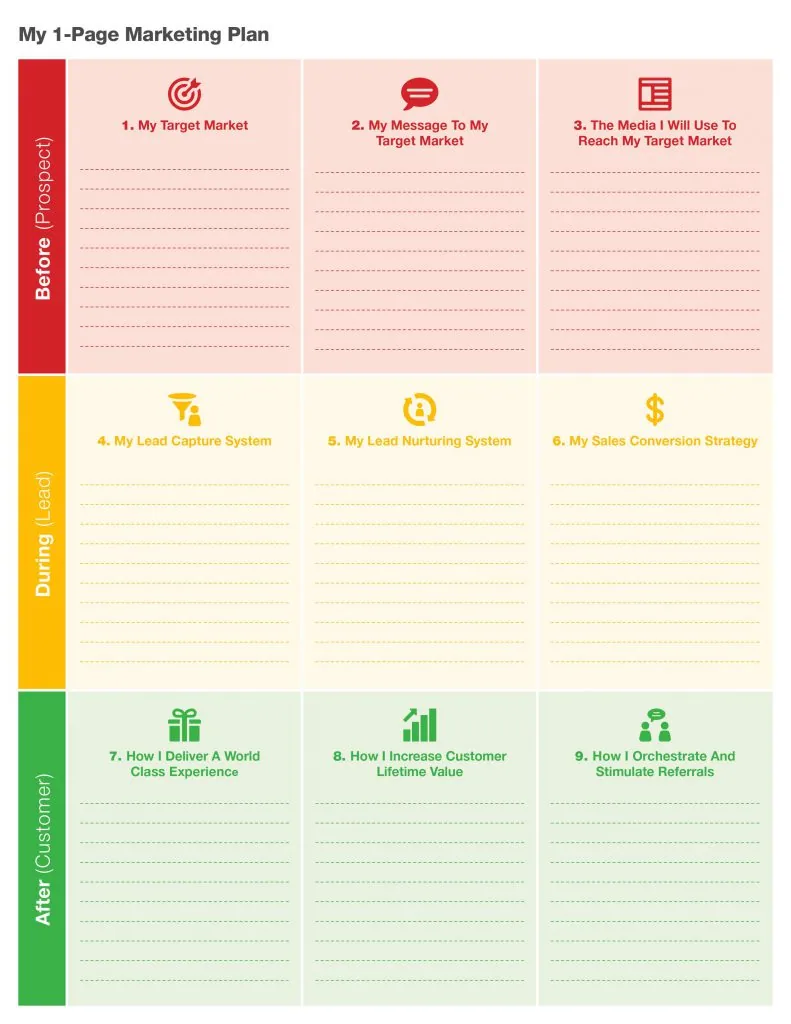
It's a nine-step framework you can complete in 30 minutes and use as a working reference. You can keep it on your desk and pull it out in a meeting. It's practical by design, built for entrepreneurs who need a real system, not a document to file away.
I developed it after seeing the same problem repeat across hundreds of businesses: they knew marketing mattered, they just didn't know where to start, what to prioritize, or how to connect their activity to actual results. The 1PMP solves that. It maps your entire marketing strategy across three phases, on a single page, in a format you'll actually use.
What are the three phases of a marketing plan?
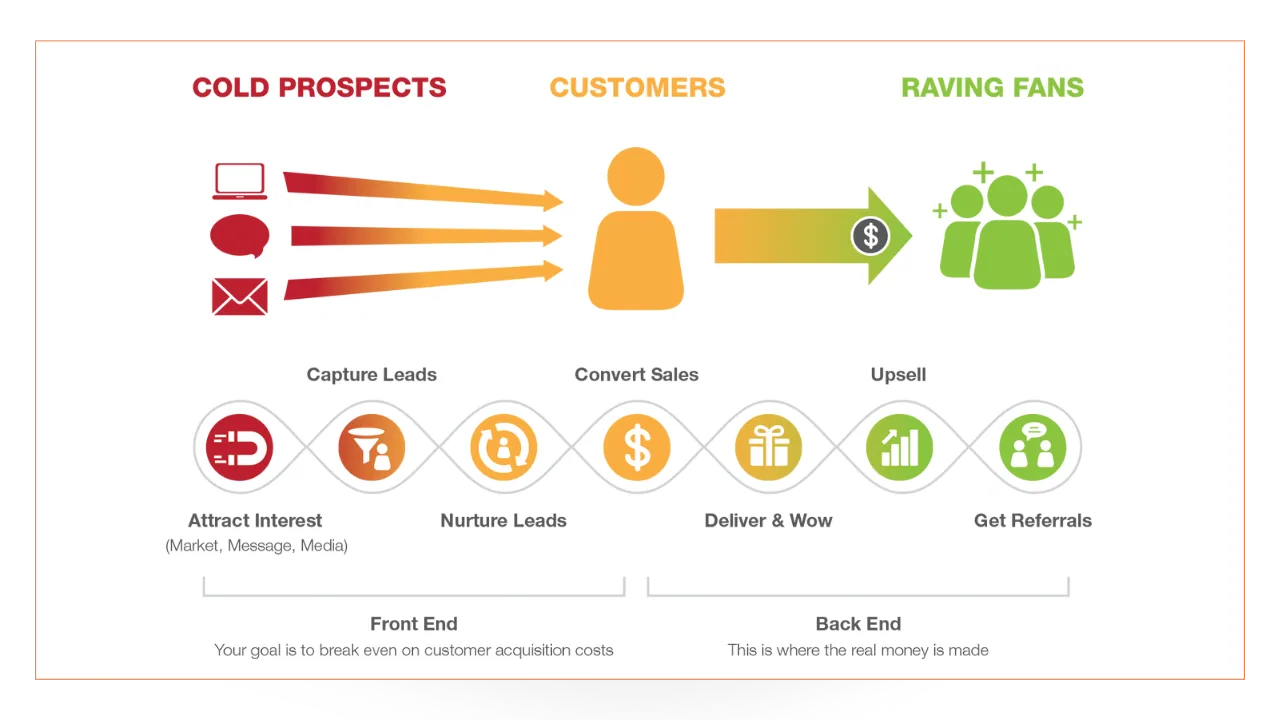
Every customer starts as a stranger. They don't know who you are, then they find you, then they buy, then they stay. The three phases of the 1-Page Marketing Plan map to that journey.
The Before Phase: How do you get prospects to notice you?
Unless you're a household name, your ideal customer doesn't know you exist. The Before phase is about changing that.
Think of it like the classic movie scenario: you want to connect with someone moving in completely different circles. You're not on their radar at all. The only way to get noticed is to show up where they are, with a message they actually care about. That's what the Before phase focuses on.
It answers three questions:
Who is your niche target market?
What message will resonate with them?
What media will you use to reach them?
The During Phase: How do you convert interest into trust?
Leads are people who've raised their hand. They clicked, signed up, attended a webinar, downloaded something.
The During phase is about building on that interest and moving the relationship forward. This phase is not about selling. The aim is becoming the most useful voice in your target market's world, so that when they're ready to move, you're the obvious choice.
Say you hosted a webinar on content planning and 30 qualified leads attended. You noticed the questions they asked, so you write blog posts that address those exact problems. You share those directly with the leads. You eventually offer five of them a free audit at a massively discounted rate. They see the value and become paying customers. That's the During phase in practice.
It answers:
How will you capture leads?
What will you do to nurture them?
How will you convert them into customers?
The After Phase: How do you turn customers into raving fans?
This is where most businesses stop doing the work, and where the biggest opportunity lives.
Think of Apple customers. They don't buy just one product. They buy the laptop, the phone, the watch, the tablet. It doesn't matter that competitors have better specs in individual categories. Apple fans are committed, and they refer everyone they know.
That kind of loyalty doesn't happen by accident. It's the result of a deliberate experience, which is exactly what the After phase is designed to build.
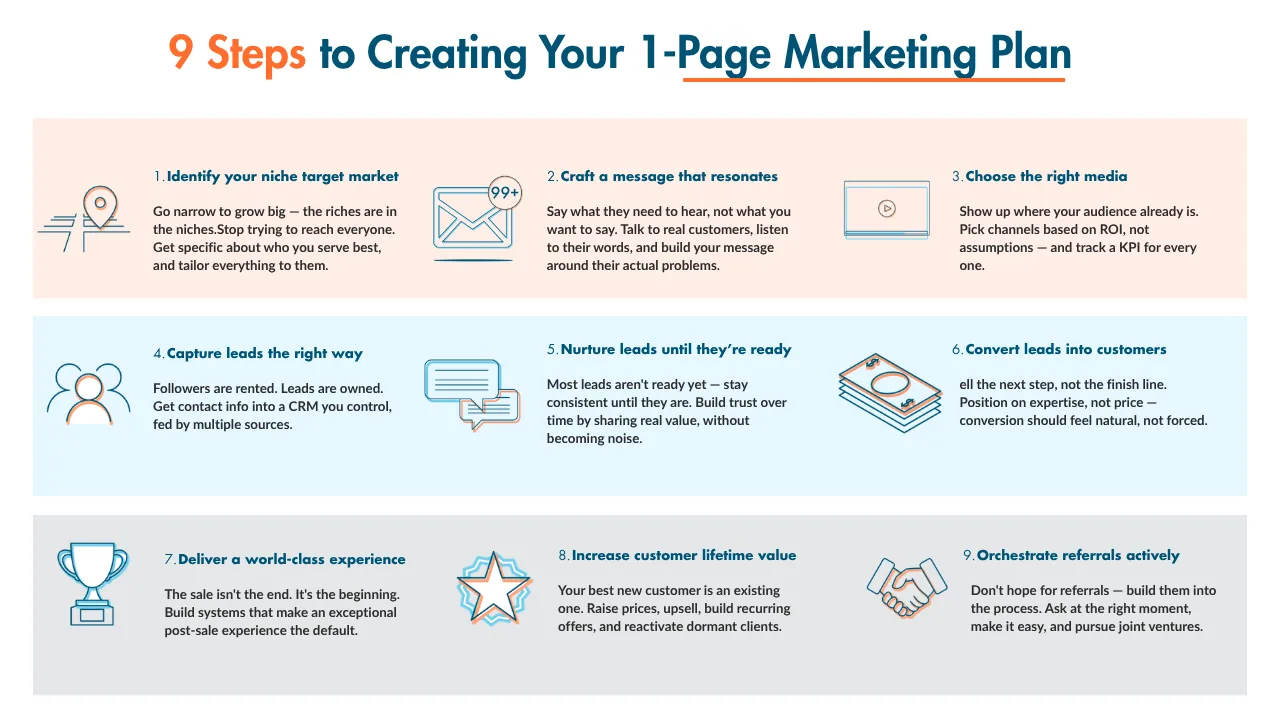
How do you write a marketing plan? The 9-step framework
Identify your niche target market.
What’s your message to your target audience?
What media will you use?
How will you capture leads?
How will you nurture leads?
What’s your sales conversion strategy?
How will you deliver a world-class experience?
How will you increase your customer lifetime value?
How will you orchestrate and stimulate referrals?
Step 1: Identify your niche target market
The biggest mistake in marketing is trying to reach everyone. A broad target is an expensive target because your message has to be generic enough to apply to everyone, which means it connects with no one specifically. Your goal is to become a big fish in a small pond. The more specific you can get about who you're serving, the more everything else in your marketing can be tailored to that group.
I worked through this myself when building Lean Marketing. Business education was too broad. Marketing education was still wide. I kept narrowing until I found the gap: marketing planning.
Business owners needed a practical, usable system for this, and almost nothing existed at that level of specificity.
Where do you have a real advantage over alternatives?
If you're stuck, use segmentation. Take your broad market and keep subdividing by industry, company size, problem, or stage of growth, until you find a group you can serve better than anyone else.
Getting this right means getting off your desk and talking to customers.
Ask open-ended questions.
Listen to how they describe their problems in their own words.
Pay attention to their body language.
If they're nodding and leaning in, you're onto something. If they're reaching for their phone, you've lost them.
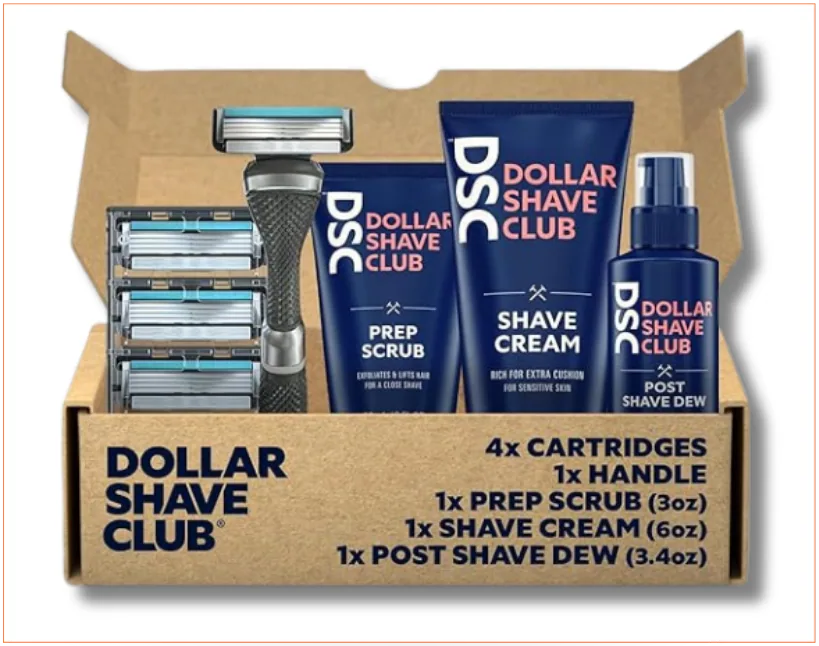
The Dollar Shave Club didn't invent razors. They noticed that men hated shopping for them and built a subscription delivery service around that insight. Unilever paid a billion dollars for the company. They didn't win on product. They won on message.
Why should they buy from me instead of a competitor?
Your business story is part of this. How you started, what you learned, what you got wrong. Storytelling makes you stand out in a crowded market because no one else has your story.
Step 3: Choose the right media
The only measure of a media channel is whether you got a return on what you invested. That's it.
The right channel is wherever your target market actually spends time, which is not always where you assume. Many business owners make wrong assumptions about this.
The fix is simple: ask your customers directly.
Where do they go for information?
What do they read?
What communities are they part of?
Once you know, pick channels based on your budget and your goals. You can spread across multiple sources or double down on two that are already producing results. What matters is that every channel has a KPI attached to it:
How much traffic should it generate?
How many leads should it produce?
What conversion rate are you targeting?
Track everything. Move budget toward what's working. Cut what isn't.
Step 4: Capture leads the right way
Social media followers are not leads. They're rented attention on someone else's platform. If that platform changes its algorithm or shuts down tomorrow, you lose access overnight.
Real lead capture means getting contact information into a system you own and control. That system is a CRM, and it's non-negotiable. It's what allows you to follow up, automate sequences, and track conversations at a scale that's impossible to manage manually.
Answer these questions to build your lead capture strategy:
What will you offer that's valuable enough for someone to trade their contact information?
How will that lead flow into your CRM automatically?
What happens in the first 24 hours after someone opts in?
Don't rely on a single lead source. Your book, your website, a podcast, a landing page, PR, referrals — the goal is multiple streams, all feeding into one system you own.
Step 5: Nurture leads until they're ready
Most leads aren't ready to buy the first time they engage with you. They're curious. They're evaluating. They might not buy for months. Lead nurturing is where you close that gap.
Consistency is everything here. Almost half of small businesses spend fewer than two hours a week on marketing. At that level of attention, you can't build the kind of sustained trust that converts leads into clients at any real scale.
Ask yourself:
What can I share that genuinely helps my prospects?
How often will I reach out without becoming noise?
How will I know when the timing is right to make an offer?
Step 6: Convert leads into customers
If you've done the work in Steps 1 through 5 correctly, conversion should feel natural rather than forced.
You've built the relationship, delivered value, and become a trusted source. The sale is the next logical step.
The most common mistake at this stage is positioning on price. When you compete on price, you're in a race to the bottom; there will always be someone cheaper. Position on expertise instead. If you've shown that you understand your client's problem better than anyone and have a proven system for solving it, price becomes a much smaller part of the decision.
Map out your sales process. What's each stage? What triggers the next step? What offer, trial, or guarantee makes the decision easier? Sell the next step, not the end state.
Step 7: Deliver a world-class experience
A sale is not the finish line. It's where the real relationship starts.
What it would mean to deliver an experience so good that clients talked about it.
What systems would need to be in place to make that the default, not the exception?
Build those systems into how you operate, not as a bolt-on.
Step 8: Increase customer lifetime value
Your existing customers are the most profitable revenue source in your business. They already trust you. Selling to them costs a fraction of what it costs to find a new customer.
Five ways to increase customer lifetime value:
Raise your prices. If your results are strong, clients who value what you do won't walk.
Offer an ascension plan that moves clients into a higher-value tier over time.
Build a subscription or ongoing offer that creates recurring revenue from clients who are already happy.
Run a reactivation campaign targeting dormant clients. A well-timed message to someone who hasn't bought in six months can be one of the fastest revenue moves in your business.
Word of mouth is the most powerful marketing you have, and the least reliable if you leave it to chance.
Most business owners quietly hope for referrals. Hope is not a strategy.
Build referrals into your process. Ask for them at a high point right after a client gets a result, when they've just told you they're happy, when a project completes. Make it easy by giving them the words to use.
Joint ventures are another route: find businesses that serve the same clients without competing with you, and build a formal arrangement that benefits both sides.
Who needs a marketing plan?
A marketing plan is a system for marketing an offer that already works. If you don't yet have clear product-market fit, if customers aren't paying and staying, fix the offer first. A plan will help you reach more people, but it can't create demand for something the market doesn't want.
It also won't help if you write it and walk away. A marketing plan works because you use it, review it, and update it as your results come in. If you want a document to hand to a bank or investor, that's a business plan. If you want something you run your marketing from week to week, that's a 1-Page Marketing Plan.
What is the purpose of the 1-Page Marketing Plan template?
According to Sophia Xiang of The Daily Nova, The 1-Page Marketing Plan provides the proverbial map to treasure: explicit instructions for making money, simplifying what would have been a tedious, complicated task into a manageable, concise plan."
The 1-Plan Marketing Plan is an implementation breakthrough that's simple and easy to do. It’s a nine-step framework that you can literally put together in 30 minutes.
It's built for entrepreneurs.
It's built to be practical.
It's built to be something you use, not leave hidden in a drawer. You can place it on your wall or your desk and refer to it routinely.
Now I've used this marketing plan example in my businesses, and with many of my coaching clients. I know it works. So let's get cracking on building your marketing playbook so to speak.
Enter your email address below to get free updates
You’ll get new articles delivered straight to your inbox, plus special subscriber-only content such as podcasts, videos and live training events.